
Sense the field
Review soil moisture, temperature and humidity from configured sensors by farm zone.
CAPYF · FARM INTELLIGENCE
CapyF connects sensor, environmental and operational data with AI to help farm teams understand conditions and decide what to do next.
01 / The operational problem
Low soil moisture means little without knowing the crop, zone, recent conditions and watering setup. Farm monitoring becomes practical when readings lead to a check the team can make and an action it can evaluate.
02 / What the user sees
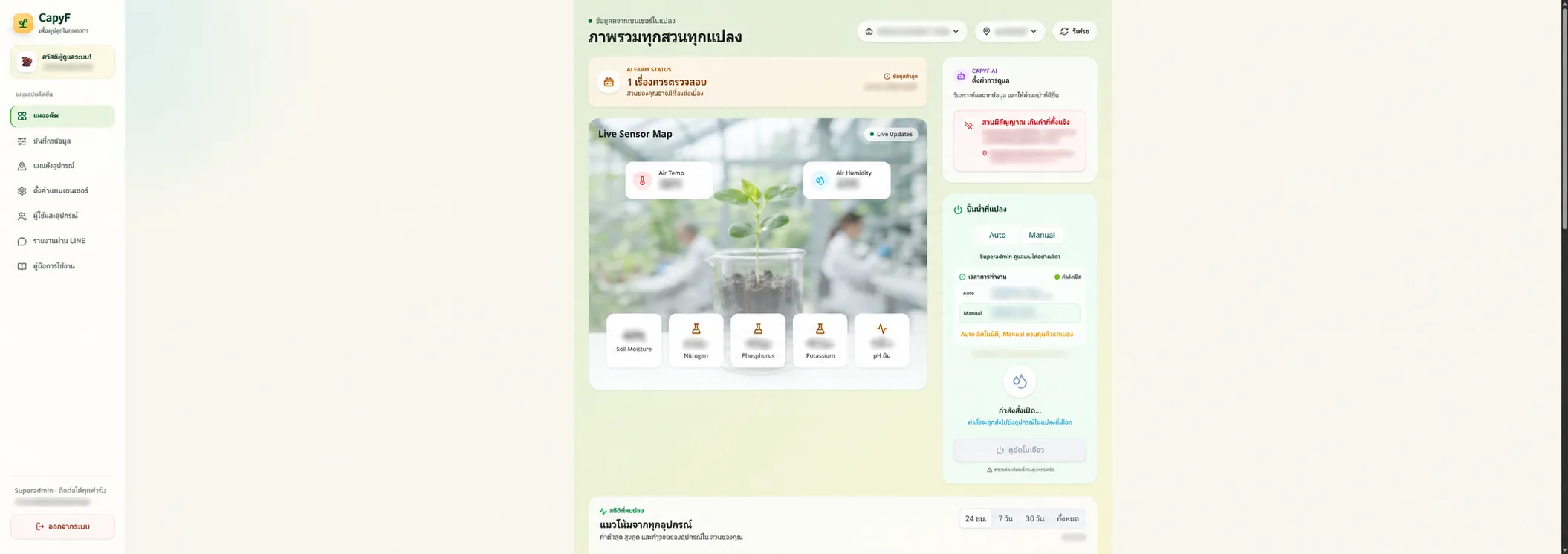
Review soil moisture, temperature and humidity from configured sensors by farm zone.
Read trends alongside crop settings and recent field activity, including whether data is current.
Use care guidance and irrigation planning to decide what to inspect before watering.
Review connected pump controls and LINE account interactions where configured for your installation.
03 / The role of AI
The farm advisor helps interpret field conditions and suggest what to review next. Irrigation planning also uses configured crop and watering inputs. Weather or forecast context should be verified for the location; an automatic forecast feed is not promised here.
AI advice is not a guarantee of crop health or irrigation results. The operator confirms field conditions and remains responsible for action. Automatic and manual pump modes depend on the connected controller and configured settings; AI advice is not a claim of autonomous irrigation.
04 / Fit with existing systems
The conceptual path is sensor → controller → cloud → CapyF → advisor → user. Current product scope includes sensor readings, watering plans, pump commands and linked LINE account interactions. Confirm controller compatibility, field connectivity and command feedback before enabling control at a site.
05 / Implementation
Choose the farm zone, crop and decision to support.
Check sensors, controller, connectivity and reading quality.
Set zone context, care thresholds and the agreed control permissions.
Compare recommendations with field observations and review the outcome.
Scope and implementation plans depend on data, existing systems and team readiness, and are agreed after discovery.
For growers, farm operators and teams who need to understand conditions by zone and review irrigation decisions with field context.
Bring the crop, zone layout, available sensors and current irrigation setup. Start with one practical field decision.
The conceptual path is sensor → controller → cloud → CapyF → advisor → user. Current product scope includes sensor readings, watering plans, pump commands and linked LINE account interactions. Confirm controller compatibility, field connectivity and command feedback before enabling control at a site.
AI advice is not a guarantee of crop health or irrigation results. The operator confirms field conditions and remains responsible for action. Automatic and manual pump modes depend on the connected controller and configured settings; AI advice is not a claim of autonomous irrigation.
06 / Your next step
Bring the crop, zone layout, available sensors and current irrigation setup. Start with one practical field decision.
Opens an email draft. Nothing is sent until you send it.